
Looking for a reliable reference to understand the history of the Puy du Fou from its origins to the present day and prepare a successful group stay? This is a clear, precise and practical guide, written for coach operators, travel agencies, associations and works committees that include the Vendée in their programmes. You will come away with key dates, concrete examples and advice tailored to group tourism.
The history of the Puy du Fou: from its Vendée roots to 1977
From the very beginning, the Puy du Fou has been bound up with the memory of the Vendée and the silhouette of the ruined castle of Saint-Mars-la-Réorthe, near Les Herbiers. The site overlooks unspoilt bocage countryside, the perfect setting for telling epic stories rooted in several centuries of history. Here you find a powerful natural backdrop that inspired a cultural project unlike any other, far removed from fairground rides, with drama as its guiding thread.
In 1977, Philippe de Villiers discovered these ruins and devised the first story that would give birth to the Cinéscénie. The project relied on a local association and on the energy of an area deeply attached to its traditions. This local foundation would shape the artistic signature of the site, with history told by the people who live there.
From the very first meetings, the project brought together elected officials, residents and businesses. A chain of solidarity quickly formed, from sewing the costumes to building the stage and setting up the sound system. This initial momentum made it possible to stage a first night-time show the very next summer, with limited resources but clear ambition.
The project led by Philippe de Villiers
Philippe de Villiers set out a clear vision as early as 1977: to tell history in the open air, with volunteers and technology serving emotion. He established a style of storytelling that was popular yet demanding, refusing approximation and embracing a lively pace. You find this guiding principle season after season, with constant care given to sets and costumes.
From the outset, the team resisted the temptation of a conventional theme park. It chose live performance, original music and stagecraft. This artistic direction carved out a unique path in France, and then in Europe, with moving stages, water jets, horse-drawn teams and precision pyrotechnics.
The association provided the legal framework for the venture and secured its governance. Note its model of being “unsubsidised in its operations”, funded by ticket sales, ancillary revenue and reinvestment. This framework reinforced budgetary discipline and led to step-by-step growth, in line with visitor numbers.
Volunteers and Vendée identity on the move
From 1978, the volunteers — the Puyfolais — shaped the site’s DNA. They sew the costumes, build the sets, rehearse the scenes and welcome the audience. You will meet entire families who take part every summer, with skills handed down from one generation to the next.
This human strength has forged a style: a popular, precise show that is true to the Vendée. The Puyfolais perform their own history and share a regional memory carried by music and light. This unique social bond makes the experience sincere, far from a mere tourist attraction.
Over the seasons, the number of volunteers has grown to more than 2,000, spread over several evenings. Today you benefit from a well-oiled organisation, with schedules, technical teams and visitor logistics sized for giant grandstands.
From show to institution: the Grand Parc takes centre stage
After the first success in 1978, the team prepared a daytime extension. The Grand Parc opened in 1989, with historical entertainment and craft demonstrations. The Puy du Fou thus went from a night-time event to a complete destination, able to fill an entire day.
Daytime shows soon became the backbone of the visit. Falconers set up, medieval scenes appeared, then reconstructed villages began hosting workshops. The site is organised into zones, with shady paths, grandstands and signage that makes your group’s movements easier.
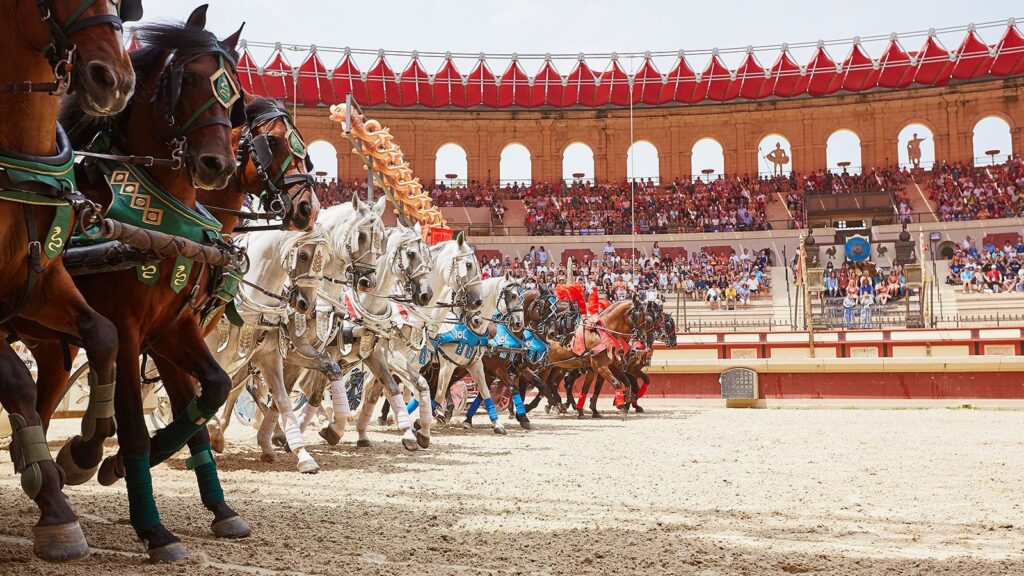
The 1990s and 2000s confirmed this shift. The park multiplied its productions: Vikings, musketeers, knights and gladiators all took to the stage. There is a common thread: short, dense and spectacular shows, scheduled at regular intervals to spread visitor flows.
The birth and popular success of the Cinéscénie
On 16 June 1978, the curtain rose on the Cinéscénie for the first time. This epic fresco tells the story of the Vendée through the saga of one family across several centuries. You witness a choral narrative that combines original music, projections and cavalcades.
Over the decades, the Cinéscénie has expanded its stage and enriched its effects. The grandstand now seats around 14,000 spectators a night, with nearly 28 performances a season. Thousands of volunteers take turns playing the roles, supported by professional technical teams.
This popular success appeals to French and international audiences alike. Bookings open early, and evenings sell out several weeks in advance. It pays to plan your group dates ahead, especially between late June and early September.
Immersive staging that pioneered the way in Europe
The Puy du Fou develops its technology without sacrificing emotion. Sets rise up, stages slide, ships sail on, and façades go up in controlled flames. You experience an immersion that alternates between silence, acceleration and choreographed tableaux.
The teams use monumental video, 3D sound and hidden sprinkler systems to create rain or mist effects. Illuminated drones draw shapes in the night sky and strengthen the storytelling. You can sense a constant quest to push the boundaries of lighting and spatial sound.
Every innovation follows one simple rule: the technique takes a back seat to the story. The show remains easy to follow, even for non-French-speaking audiences. You follow a clear story, with strong visual cues that are accessible to groups of all ages.
Key dates for group organisers
| Year | Milestone | What it means for your groups |
|---|---|---|
| 1978 | First Cinéscénie | Birth of the night-time show, to be booked early |
| 1989 | Opening of the Grand Parc | A full day of shows and villages |
| 1990s | Roll-out of daytime shows | Tightly timed schedules, ideal for coach groups |
| 2011 | Gallo-Roman arena and Le Signe du Triomphe | Greater capacity and large grandstands |
| 2016 | Le Dernier Panache | A new narrative milestone in an indoor theatre |
| 2019 | Le Premier Royaume | Immersive staging on the story of Clovis |
| 2020 | Les Noces de Feu | A night-time show on the lake to broaden the offer |
| 2021 | Puy du Fou España (Toledo) | A new possible destination for your tours |
| 2023 | Le Mime et l’Étoile | Visual innovations inspired by early 1900s cinema |
The impact of the Puy du Fou: culture, jobs and influence
The park has become a regional cultural driving force. It has revived historic crafts (stonemasonry, saddlery, falconry, period dressmaking) and created an original repertoire. Highlight these special features in your client briefings, as they clearly set the experience apart.
Economically, the site employs thousands of people in high season, including permanent staff, seasonal workers and freelance performers and technicians. Local accommodation, restaurants and transport benefit directly from longer stays. You will find a well-structured sector, with partners firmly rooted in the Vendée.
Its influence reaches beyond France’s borders, thanks to the international awards it has received and its artistic exchanges in Europe. The Puy du Fou now exports its expertise while boosting the appeal of the département. You benefit from a reputation that reassures your clients, especially those visiting the Vendée for the first time.
Group tourism and benefits for the area
The infrastructure caters easily for groups: dedicated coach parking, e-ticketing and reserved queues. The restaurants handle large numbers, with set menus timed around the show schedule. You can make the most of your breaks without missing a major show.
Stays become longer with the Cité Nocturne and the themed hotels. You can then offer “day + night + Cinéscénie” packages, which boost satisfaction while simplifying logistics. Senior, school and association groups all enjoy a tangible level of comfort.
The whole area benefits: nearby accommodation providers, local producers and partner visitor sites. The Puy du Fou is often combined with the Marais Poitevin, Maillezais Abbey or the Vendée coast. This combination adds value to your tour and spreads the economic benefits.
Training talent and local know-how
The Puy du Fou runs in-house workshops for carpentry, costume-making, stage machinery and saddlery. These units train professionals who can assemble a set, look after a horse team and make a stage effect safe. You can sometimes visit these spaces as part of a tailor-made programme.
The company also runs training courses in the performing arts: equestrian stunts, acting, stage management and sound and lighting control. The teams pass on precise protocols that matter for both safety and artistic quality. The result is a consistent standard of performance throughout the season.
These skills spill over into the local ecosystem (costume makers, livestock breeders, craftspeople, equipment hire companies). Annual contracts guarantee volumes and stabilise jobs. You therefore work with reliable suppliers who can cope with sharp peaks in activity.
How has the Puy du Fou evolved from 1977 to the present day?
Since 1977, the Puy du Fou has moved forward in stages. It created the Cinéscénie, then a daytime park, then hotels, then additional night-time shows. You can now plan two-day stays to cover the essentials without rushing.
The park focuses on quality rather than piling on new attractions every year. Investment targets capacity, comfort and immersion. You will notice better-managed queues, covered or partly covered grandstands and more shaded areas.
This evolution puts the emphasis on historical storytelling, with creations such as Le Dernier Panache (2016), Le Mystère de La Pérouse (2018) and Le Premier Royaume (2019). Les Noces de Feu (2020) and Le Mime et l’Étoile (2023) have refreshed the evening offer and the visual language. This lets you build varied itineraries, even for clients who have been before.
Modernisation, technology and accessibility
The control rooms are gradually adopting 3D audio, laser projectors and giant LED screens. The shows combine heavy machinery with millimetre precision. You benefit from greater reliability, with show times kept to the minute.
The park is improving how visitors get around: wider paths, shuttles at peak times and clear maps handed to group leaders. Access for people with reduced mobility is clearer, with reserved seats in the grandstands and adapted routes. You can easily point these out in your travel documents.
On the inclusion side, several shows offer hearing loops and audio description. The welcome teams guide visitors and suggest alternatives where a show is not advisable. This helps you make your association and intergenerational trips more accessible.
New shows and a well-managed season
The programme strikes a careful balance between new creations and updates. Le Signe du Triomphe, Le Secret de la Lance, Les Vikings, Le Bal des Oiseaux Fantômes and other cornerstones anchor the year. Major new shows then arrive every two to three years, which makes it easier to sell the destination again.
The season for the Grand Parc generally runs from April to early November, peaking in summer and on long weekends. The Cinéscénie’s dates are concentrated between June and September. Secure your allocations early, especially for Saturdays.
The themed hotels — Villa Gallo-Romaine, Îles de Clovis, Camp du Drap d’Or, Citadelle, Le Grand Siècle — allow you to organise stays with day trips from a single base. You can segment your audiences: school groups in spring, seniors in June and September, families in summer. This approach keeps satisfaction high and balances visitor flows.
Going international: the Puy du Fou and its sustainable future
The Puy du Fou has built up expertise that it now exports. Its model is based on local historical storytelling, an open-air site and high-intensity shows. You are following a French brand that is proud of its identity and is opening up to other countries.
The company adapts its methods to each host culture, with original writing and local teams. The aim is to create shared emotion that can be understood without heavy translation. You will find the same hallmarks: original music, monumental sets and a brisk pace.
In this international expansion, the parent site in the Vendée remains a testing ground. Innovations are tried out in the Vendée first, before they travel. You can therefore expect a calendar of openings punctuated by technical and artistic iterations, always tested on site.
Openings in Spain, global ambitions
In Toledo, Puy du Fou España opened in 2021, following the launch of the major night-time show El Sueño de Toledo in 2019. The site offers daytime shows inspired by Iberian history and a large night-time epic. You can extend your tours into Castilla–La Mancha with a cultural stop that French-speaking groups find very easy to follow.
The Spanish success confirms the relevance of the model outside France. Local teams take over the training and adapt the stories to national landmarks. You can thus add a complementary experience to your Madrid–Toledo–La Mancha tours.
The group is studying other international locations and is moving forward cautiously, with high artistic standards. No dates are announced until the conditions are right. Keep an eye on these projects to anticipate future products.
Measurable environmental commitments
The Vendée site is working on biodiversity and energy. The teams maintain bocage hedgerows, replant woodland and manage bodies of water that cool the microclimate. You walk through a landscaped park of more than 150 hectares, designed to provide shade and coolness.
The workshops favour reusing materials, repairing and upcycling costumes. Biomass boilers heat several of the hotels, and LED lighting throughout reduces consumption. You can see concrete efforts linked to maintenance and to extending the life of equipment.
Recent night-time shows use fewer fireworks and rely instead on light, music and drones. The park also encourages green travel, with bike parking and charging points for electric vehicles. Highlight these initiatives in your CSR arguments and tender responses.
Planning a group tour to the Puy du Fou? Share your dates, your group profiles and your constraints with us: we will build a smooth itinerary with optimised seating and a stay that everyone will love. Contact circuitgroupes.com for a quick quote and practical advice tailored to your specifications.
FAQ
Q: How much time should a group allow for a visit to the Puy du Fou?
A: Allow at least a full day for the Grand Parc, and add an evening if you book the Cinéscénie. To cover the essentials without stress, two days on site give you the ideal pace.
Q: When should a group book the Cinéscénie?
A: Place your options several months in advance, especially for Saturdays from June to September. The best seats go quickly, so confirm your numbers and any reduced-mobility needs early.
Q: Is the park suitable for school groups and seniors?
A: Yes. Itineraries can be adapted and the grandstands have reserved areas. School groups benefit from concrete educational content, while seniors appreciate the easy access and the well-timed programme.
Q: Where can a group stay close by?
A: Find hotels for groups near the Puy du Fou or restaurants for groups near the Puy du Fou